
Wall Theory
Wokeness was born in November 1989

This essay lays out a new theory on the origins of wokeness. Compared to other theories it has these advantages:
It explains why wokeness exploded specifically between 2010-2012.
It explains why The Current Thing changes so rapidly.
It explains why it was able to leave the academy and so quickly conquer business.
It leads to a hopeful and actionable conclusion.
The Story So Far
The last twelve months have seen several credible attempts to explain where the social phenomenon known as wokeness came from, and why it seemed to start so suddenly around 2010:

The above chart comes from David Rozado, who in this tweet from 2019 showed a sudden step change in the use of many different words associated with wokeness. This just confirmed what most people already intuited, but seeing it plotted was arresting:
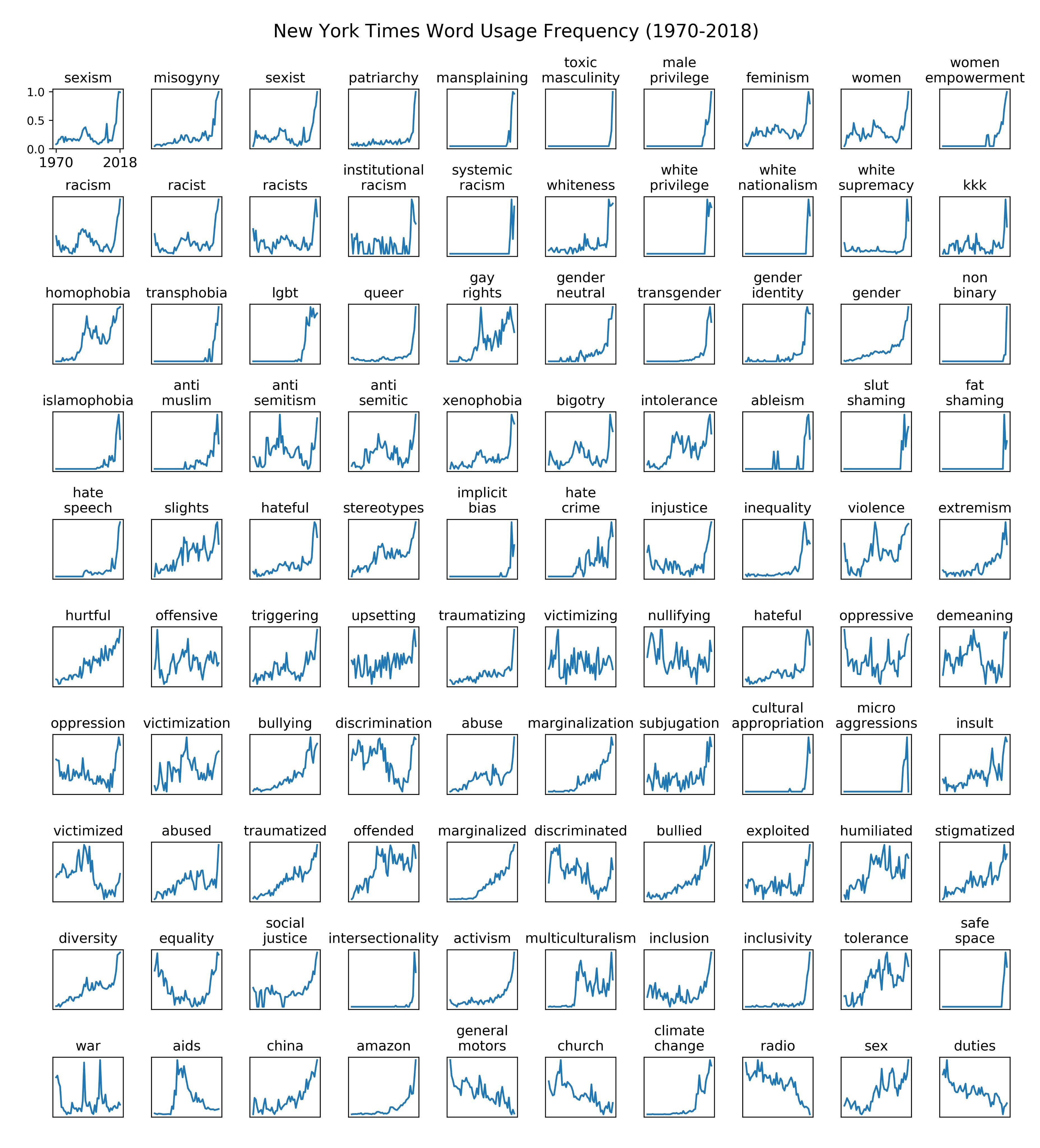
Not only do many different woke words explode starting around 2012 but the concept of wokeness itself emerges around this time, as can be seen by counting uses of the term in books:
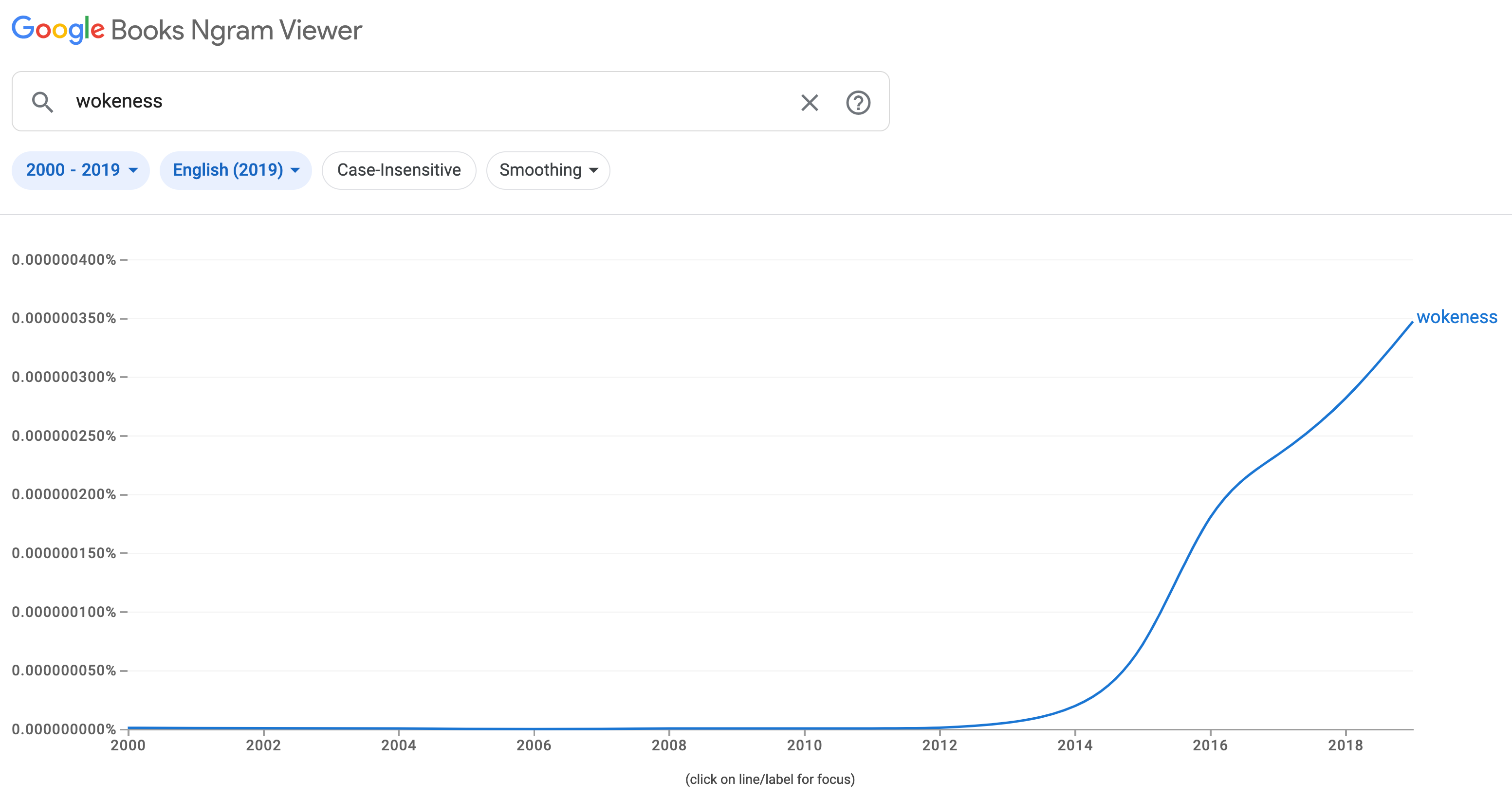
This timeline poses difficult questions. It’s very unclear what was so special about 2012. The search for an explanation began.
Many felt that wokeness was an American export. In his book “The Origins of Woke”, Richard Hanania argues that it all traces back to American civil rights law passed in the 1960s. Hanania marshals significant evidence that wokeness is in fact obligatory under US law, and US corporations are thus legally obliged to spread it through their international offices and output to the rest of the world.
Other attempts to explain wokeness by writers like Chris Rufo or Nathan Cofnas are similarly US centric, arguing that what happened was the result of long term trends in American academia, or how American society thinks about race.
But a year ago Rozado extended his analysis to many other countries and showed that the phenomenon happened in a synchronized fashion everywhere at once:
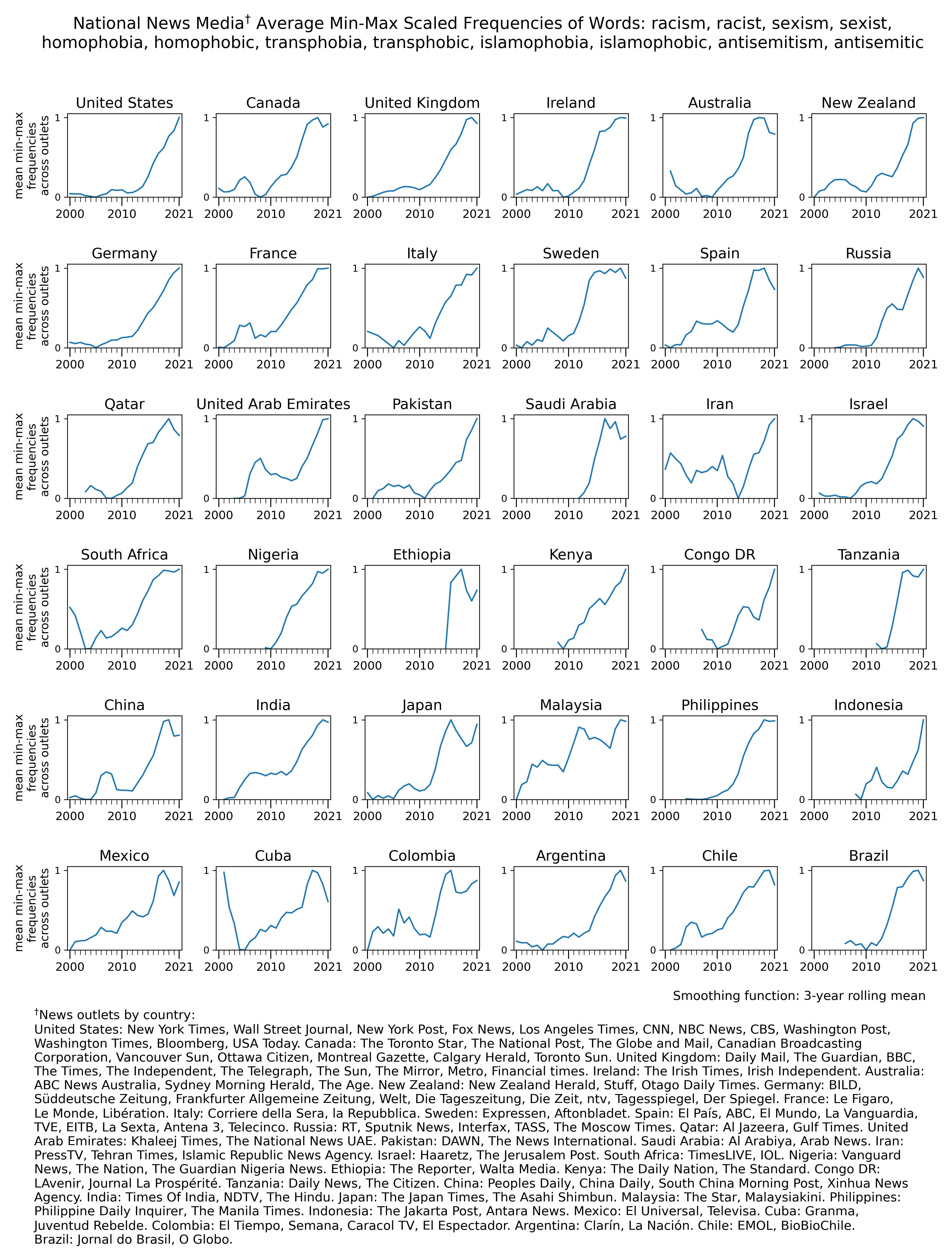
A few of these charts don’t show any explosion of wokeness (Iran), or are lacking in sufficient data (Ethiopia), and still others don’t tell any clear story at all, like Cuba. And if you break the data down the exact flavor of wokeness differs in predictable ways, e.g. America is all about race, Israel is all about anti-semitism, Islamophobia is big in Europe and so on. Still, the synchronized nature of these linguistic trends seems clear.
Noah Carl makes the “somewhat speculative” argument that maybe it’s still all the American’s fault because everyone just copies the US. But this explanation is unsatisfying. America has many cultural exports that other countries don’t mimic like the staunch support for Israel, gun rights culture, baseball and so on, which have all had little impact on the rest of the world. Why should this thing be so different? And it still doesn’t answer what changed in 2012.
The closest anyone has got to an explanation that actually pins things down in time and space are to blame the Dark Duo of smartphones / social media. It’s a weak explanation, partly because these phenomena are invoked to explain absolutely every trend anyone anywhere doesn’t like, but mostly because there isn’t a great theory fleshing out the details. Social media could have accelerated a lot of trends: why these specifically? And it’s not like internet-based communication started in 2010. MySpace was founded in 2003, the same year as Facebook. YouTube got started in 2005 and immediately conquered the video market with social features. Forums and blogging were abundant between 2000-2010. In fact the writer Scott Alexander has previously noted that the earliest place wokeness seems to emerge on the internet is not smartphone oriented social networks, but rather the New Atheist/Geek Feminist blogosphere.
It’s frustrating. Nothing proposed so far seems to work.
So I posit another theory, one that can answer why 2012 with a highly specific social and temporal explanation: wokeness arising in 2012 is a direct consequence of the collapse of communism in eastern Europe twenty years earlier.
A brief history of the 20th century
The Berlin Wall fell in November 1989. Unlike in prior decades when communist regimes hit trouble, this time Moscow did not ride to the rescue. The Soviet Union was too busy facing its own collapse in morale. In that same year Boris Yeltsin had visited Texas on a diplomatic mission to NASA. Yeltsin was a senior Soviet official and newly elected to the USSR’s “parliament”. He had got into the habit of doing surprise inspections, a necessity in a society where everyone habitually lied to managers about the true state of things, and decided to give the Americans a surprise inspection of his own. Without warning he suddenly demanded his hosts take him to a local supermarket. They were baffled but complied.
Yeltsin wasn’t mentally or emotionally prepared for what he saw:
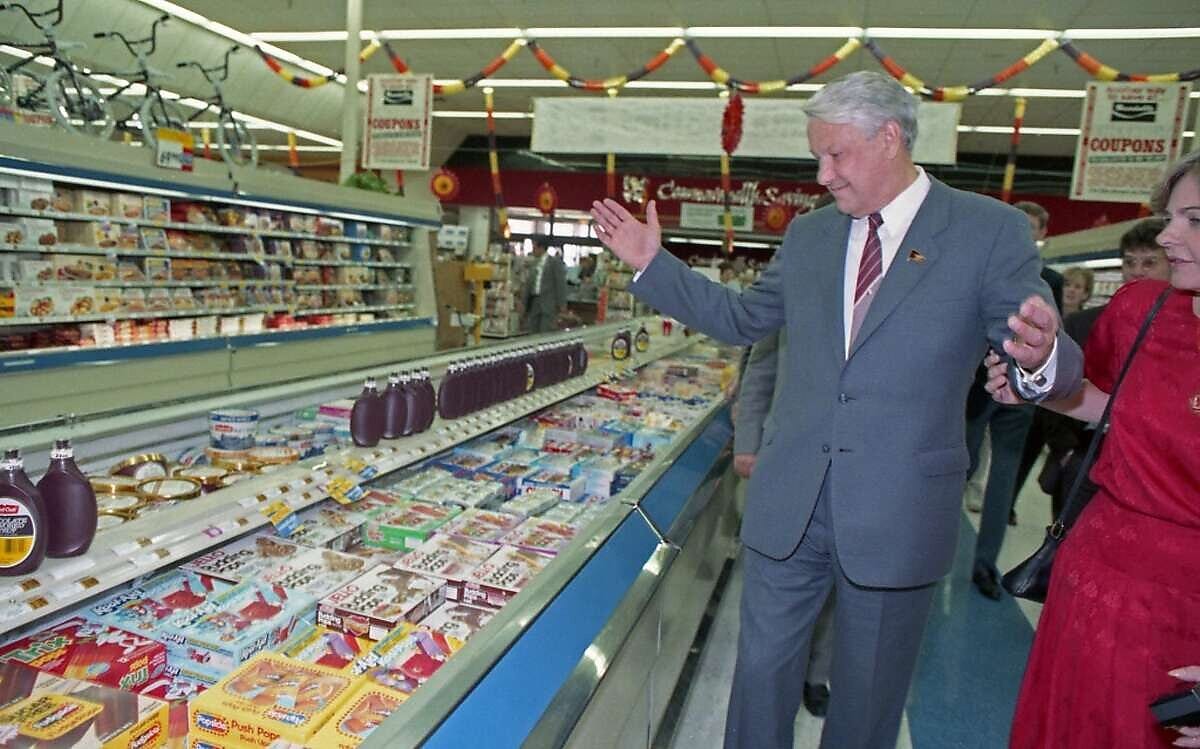
Endless aisles overflowed with uncountable delights! He asked how many products were available for sale in this specific store; when he was told 30,000 he thought his translator was making a mistake. It’s easy to understand his confusion. This is what Soviet supermarkets looked like at the time:
From “Yeltsin, A Revolutionary Life” by Leon Aron:
For a long time, on the plane to Miami, he sat motionless, his head in his hands. ‘What have they done to our poor people?’ he said after a long silence.
… it was at that moment that “the last vestige of Bolshevism collapsed” inside [him]
Just two years later the USSR collapsed and Yeltsin became the president of Russia. As important as when was why: in a very real sense, the hard left simply gave up on their own system. And not only in eastern Europe either: Deng Xiaoping was simultaneously moving China towards capitalism.
The left had enjoyed a relatively high degree of ideological stability throughout the 20th century. Its hatred of capitalism and the lingo that went with that hadn’t changed much since Marx began writing Das Kapital in the 1850s. In the UK the “Labour family” that had voted left for generations was a familiar sight and a core source of stability for the party. But as the west steadily pulled ahead, subfactions of the left reacted to the declining credibility of communism by peeling off in waves that prioritized racism (in the USA) and feminism/environmentalism (everywhere else). This was a trend that accelerated in the 1980s. Still, the institutional and intellectual might of the left had a lot of inertia and by the early 90s was still associated in the public mind with a strong dislike of free markets.
Then, dawn broke. People emerged, blinking, into a new world: one where God-fearing capitalism had won. In America Clinton took power for the Democrats by ruling like a conservative - he balanced the Federal budget and called himself a “New Democrat” who followed the “Third Way”. In Britain Labour got its extremist youth wing under control, allowing an energetic member called Tony Blair to recruit a new generation of young people. For the first time these were “university-educated and professionally employed, as much in the private as in the public sector” (Mandelson). When Blair brought Labour back to power in 1997 he not only adopted the “Third Way” talk from Clinton, but explicitly renounced so much left wing canon that the party was rebranded New Labour just to drive home the point. A clearer acceptance of moral and intellectual defeat was harder to find.
The 90’s kids
We think of young people as being inherently left wing, but in the 1992 British election more 18-25 year olds voted for the Conservatives than Labour. It was Thatcher’s children that definitively rejected the economic leftism of their parents, and it was this generation that gave birth to the woke generation.
At first it appears that this timeline can’t work. People born in 1991 were just babies at the time and had no understanding of politics. Nor were their parents particularly radical, being big supporters of Third Way centrists like Clinton and Blair.
But I think that in fact something very deep was happening. The underlying social intuitions that create leftism didn’t go away; after all, the left had never been motivated by economics per se. They just saw it as a highly visible example of social injustice.
As the 90’s generation approached their teenage years in 2005, they went through the usual political awakening. They began to feel deeply that there must be underdogs to side with, that there must be some class or some thing to rebel against. But with the old enemies long vanquished and the old ideas long discredited, their parents were apathetic and had no guidance to give.
Into the intellectual vacuum of 2000s-era leftism stepped candidates to become the new unifying cause. Some had more fitness than others. American teenagers got some short-term mileage out of rebelling against their parents’ Christianity, but that decaying religion provided little resistance and soon they found that being an atheist hardly granted any social currency. Besides, who exactly was the victim of grandpa’s godliness? Gays? Gay rights were a 1980s era fight, not much to do there. Science? Reason? Not very exciting. Science & Reason don’t get people out of bed and to a protest on a rainy day.
The Patriarchy was an early mainstay, as it provided the same kind of two-sided society wide conflict as Marxism had provided in the 1800s. Women are more left wing than men and it helped that feminist thought had been developed through the 80's by those early defectors from the socialist cause: sexual harassment had been a cause célèbre of the “politically correct” left even in the 90s. So the earliest woke people were all obsessed with feminism, sexual harassment and so on. But men offered too little resistance to make a hard target. Feminism was an old battle mostly won already, and feminists swiftly got everything they demanded. Also awkward: the irritating absence of unambiguous oppression. Pay gaps could be too easily explained as the result of free choice, and women had more legal rights than men. When #MeToo effortlessly steamrollered every man in its path whether justified or not, a new enemy was needed.
The search for a worthy cause became ever more rapid, but many candidates were respins and sequels to much older strands of leftism and none really fit the needs of the new generation. Racism proved highly fit in the USA due to its history, but struggled to unite the global leftist movement due to its near-exclusive focus on black people and police shootings (both quite rare in western societies outside the USA). Trans “oppression” had a high level of fitness and benefited from being new enough that the woke generation could own it, except that it led to constant battles with the 80’s feminists who were supposed to be on the same side, and who by then had been given significant institutional power. Plus there was again the problem of living in a highly egalitarian society with no real oppression to speak of, so once the conversation moved onto specific details, like who gets to use which bathrooms, significant energy was lost. Climatism was hardly better, being as it is an awkwardly scratchy hair-shirt, full of annoying people pointing out that exotic holidays were incompatible with saving the planet. Besides, the establishment had already been conquered and once again provided no real resistance.
Then Hamas happened. Other than being temporary by nature, the Palestine conflict is a fit cause for the radical left. It pitches the young in a real honest-to-god battle against the powerful establishments who genuinely disagree with them, finds them dangerous and isn’t ready to just roll over. It’s pleasingly two-sided, comes with ready made wearable symbols and lots of stories of sympathetic innocents being bombed by people who look just like their lecturers, parents and bosses. The achilles heel is of course that Hamas is guilty of cartoon levels of evil, especially towards traditional left-wing allies like women, gays and Jews. The lines between Hamas and ordinary Gazans are meanwhile so blurred they’re nearly invisible. We can predict that soon the woke will move on from this cause as well.
The Era of the Omnicause
Let’s summarize.
Wokeness took off in 2012 because that’s when the kids born in 1990 were completing their degrees and entering the workforce, free of the legacy of 20th century thought but without a replacement. It so quickly conquered institutional management because that generation - the woke’s parents - were people had been raised with left wing intuitions and had never really grown out of them. Forced to abandon their surface-level beliefs by the decisive ending of the USSR but without engaging in real reflection, they were sitting ducks for a new iteration of leftism to come along and satisfy their emotional needs. Meanwhile the whiplash-inducing cause switching is an evolutionary search to find a belief system as fit as Marxism once was. Causes are tried and discarded as their flaws become too apparent.
Why does this happen so fast? I partly agree with those who blame the internet. But I don’t think the mechanism is “filter bubbles” or similar. It’s rather the opposite: the left is having so much difficulty re-establishing the kind of ideological stability it once enjoyed exactly because the internet puts people face-to-face with an endless stream of rational skepticism and disagreement. Although it may seem at first that the woke are trapped inside filter bubbles, the reality is that those bubbles are being constantly popped by awkward questions, observations and memes, often from people within their social sphere who became exhausted from trying to keep up.
Elon Musk is an excellent example of this. He is hated by the left because he went from a highly influential progressive environmentalist to someone who injects a constant stream of memetic skepticism into the Twitter feeds of hundreds of millions of people. And why did that happen? Because he felt exhausted by the left’s constant cause switching:
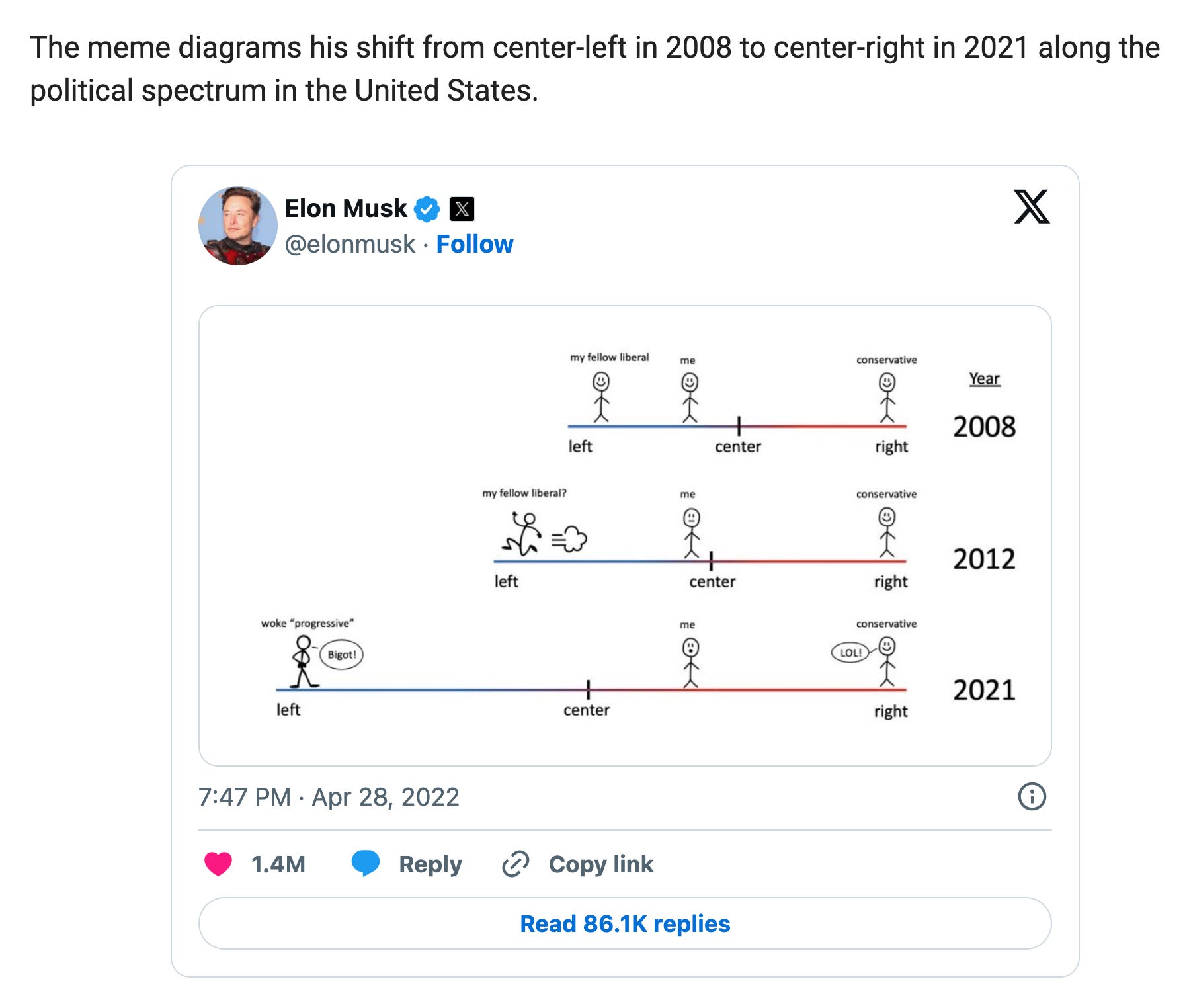
The left know this is a common problem and it makes them afraid. Leftist energy is not infinite. They became exhausted and demoralized before; I think that deep down they know it could happen again. They’re losing people and the longer their search for a revitalizing cause goes on, the more vulnerable they become.
What to do?
Wokeness is worth opposing because like all left wing movements it is a fundamentally destructive ideology that justifies the punishment of innocents via their membership of a vaguely defined group of “oppressors”. The chaos and needless social division it creates holds humanity back.
Yet wokeness is also somehow weak. Unlike earlier movements it hasn’t yet unified around a charismatic individual, and it can’t decide what it really cares about.
Wokeness can’t be killed in one go, but ending it earlier than it otherwise would have ended is possible if we adopt the following set of tactics and strategies:
Demoralization works. It worked on the DDR and the USSR, it can work again. Point out woke unsustainability at every opportunity. “Go woke, go broke” is a potent meme because it implies wokeness is not a new level of permanent human progress, but a transient phenomenon that’ll end when it’s consumed enough institutional money. This is taking time to come true because famous institutions always have a long way to fall (that’s why they’re famous), but Disney is a good high profile example of how wokeness can erase profits and kill much-loved organizations.
Look for alternative causes they could adopt. This may sound dumb but the woke are in some sense not all bad. They burn with fanatical energy because they sincerely want to help people. They are a problem because society isn’t actually defined by a duel of duals, and attempts to ignore this reality lead to malicious behavior. If they could be presented with a fitter cause to adopt they will probably seize on it. Christianity offers an interesting example here of something that was able to absorb enormous righteous energy then deflect it into arbitrary and mostly harmless rituals; the parallels between wokeness and religion are real and point to a way forwards.
Promote the morality of being mission focussed to the managerial classes. A lot of woke pushback comes from rationalist men who frame wokeness as bad because it’s inefficient at generating good outcomes. That isn’t working. Although the truly woke seek a cause, their managers came of age in a causeless world and now have families and mortgages. What they seek is moral validation: being seen to be a good person. Exactly what good person means is not terribly important. If we can build a narrative that institutions which focus on their mission are morally superior to those which don’t, managers will be receptive. And with their moral needs met, they will be much more willing to push back on younger woke employees.
Equip managers with the tools to push back. I mean “tools” here literally and may discuss this more in a future post.
The above four ideas are not yet a detailed battle plan, but they are I think interestingly different to the usual conclusion-less hand-wringing that typifies anti-woke discourse. There’s a lot more that can be said about this, and I have more concrete ideas for how to organize a fightback in practice.
I don’t know how often I’ll be able to write here, but have no plans to monetize this blog. If you’re interested in reading more then you know what to do:
On point 3, i remember the mission statement of a Japanese company. Instead of the usual vapid drivel it said "we benefit society by developing this business".
I've heard on more than one occasion that relying on logic and efficiency to sway the opinion of liberals is inherently non-productive because liberalism is, at its core, about emotions. We can see that with BLM protests in 2020 that saw numerous riots—sorry, "protests"—break out in major cities across the country which destroyed completely innocent companies, including grocery stores and mom-and-pop dining establishments that as a result closed their doors permanently. We also are seeing this in episodes of "let's-burn-Tesla-dealerships-and-key-Musk's-cars-not-because-I-hate-Elon-Musk_but-because-I'm-incapable-of-controlling-my-own-emotions" now in 2025. Logically, it makes no sense to shit where you eat (so to speak) as the original cause of buying a Tesla was to save the planet but that old order no longer applies or is relevant. Pointing out the inconsistency of logic is met with blank stares, but it doesn't stop the protesting. Some people just enjoy being offended and will search endlessly to claim their Victim Card™ if one cause falls out of fashion (read: doesn't garner as much press coverage) and for those people, there is no hope. The more centered individuals, however, need to have the **emotional** aspect of their protesting addressed. What separates conservatives from liberals (or even the center) has more to do with overlaying political affiliation with an equal bell curve of emotional (either political extreme) to logical (middle.) If you were to destroy the emotional satisfaction of a liberal affiliating with a given cause, you will destroy support for it.